Wednesday, November 22, 2006

m-payments- a good investment opportunity?

The buzz about m-payments

Mobile payments or m-payment are not new buzz in India; attempts at creating m-payment solutions go as far back as 1999 and has even seen some VC investment in the space. However, the market was clearly not ready for it and m-payment was more a conceptual experiment than any real paradigm shifting opportunity. The second coming of mobile payments in recent months is an entirely different story. It has the backing of a 135 million user base that is growing at 5% a month, and a retail economy that is poised to take off into stratosphere.

m-payment is a broad term for any mechanism that allows a user to make a payment for a service or goods, or transfer money to another person using a mobile phone. The m-payment solution typically works in conjunction with an existing bank account or credit card the user holds.

The basic hygiene factors for an effective m-payment solution are:

- Ease of use
- Maximum device support to cover a large user base
- Support for a number of banks or credit cards
- Security
- Large merchant base


m-payment providers in India:

The m-payment space in India has seen two recent investments by leading VC’s. Sherpalo Ventures and Kleiner Perkins Caufield & Byers, two of Silicon Valley’s most reputed venture capital firms invested about $5 million in Paymate, a Mumbai based m-payments solution provider and Helion Ventures invested $2.2 million in Ji Grahak, a Bangalore based m-payments company.


Paymate and Ji Grahak offer very different solutions and a comparison is shown below:

Paymate:
  • SMS based, no GPRS connection needed.
  • Currently available only for Citibank credit or debit card customers
  • Works on almost every phone model in India
  • No need to enter and submit credit/debit card details on the phone
  • Current model will only work for online purchases
  • Person to person payments currently not supported

Ji Grahak:

  • Needs GPRS and a java client to be downloaded
  • Currently available for any credit card holder
  • Works only on high end java phones
  • Need to enter credit card details at least once on the phone
  • Current model seems online focused, but no real clarity
  • Person to person payments currently not supported


The fact that Paymate works on any phone model with SMS capability, does not require the user to hold a credit card and works without GPRS makes it appear to be much more compelling proposition than Ji Grahak. Moreover, Paymate does not require the user to enter or submit card or account details over the phone, another huge benefit in India where consumers are only just beginning to become comfortable with using their credit cards online. The only advantage Ji Grahak seems to have in the short term is that it supports any credit card and is not restricted to Citibank customers. However, this may not be such a great advantage as Paymate signs up more banks eventually.

In the long run however, as data usage in India becomes more widespread (GPRS), the Ji Grahak solution offers a much more secure infrastructure for payments than Paymate’s simplistic SMS based solution. Moreover, a Java client on the phone also provides scalability in terms of exchange of information with Point of Sale (POS) systems to purchase goods in physical retail stores should Ji Grhak go that way.

While the Paymate model seems to be more in tune with Indian market needs than Ji Grahak, it still needs to address several issues in order to have a chance of success. For starters, the current model only supports on-line retailing, i.e, the user browses a web site such as rediff.com and decides to buy an item. When the user reaches the purchase screen she is presented with the option of paying via her mobile phone and enters her mobile phone number and clicks submit. If the user is a pre-registered Paymate user, then an sms is sent to the users phone with the item code and the user needs to reply with the item code and PIN number to confirm the purchase. Secondly, SMS is inherently not very secure and it’s not uncommon for messages to get lost or remain undelivered.

The biggest hurdle faced by both paymate and Ji Grahak is extending the model beyond online retailing to physical store retailing. The big advantage of m-payments in the Indian context is that it takes advantage of high mobile penetration to provide an effective alternative payment method to cash. So what exactly is the benefit of solutions that merely displace the last click of an online browse and buy transaction?

And from an investor’s point of view, what is the revenue model for m-payment providers? Both Paymate and Ji Grahak are free of charge to the user; does the merchant pay them for every transaction? Can they break even with only online merchants?

A third m-payment solution, mChq, and has been around for over a year now. This is again SMS based but the transaction process is one where the retailer/merchant sends an SMS mentioning the amount to the customer. The customer enters his/her personalized PIN number and sends an SMS back to the retailer acknowledging the amount to be paid. Both the parties then get a confirmatory SMS indicating the completion of the transaction. The mCheq solution addresses physical retailing more effectively than paymate or Ji Grahak. mChq pilots were launched by ICICI bank and Visa cards and SBI also launched a solution on the platform subsequently.


Are m-payment solution providers a good investment opportunity for VC’s?

There is no big m-payment success story anywhere in the world today, barring maybe Japan. Having said that, India probably has the best chance of producing an m-payment success story. Market factors for an alternative payment mechanism to cash are clearly evident – high mobile penetration even in tier-2 and 3 cities, relatively low credit card penetration (98% of transactions in India are cash and cheque), a relatively low internet user base and rising middle class consumption and disposable income.

The biggest challenge will remain consumer adoption. The market is large enough to support 3-4 m-payment solution providers with different solutions that cater to different consumer segments. Moreover, competition is essential to create consumer and merchant adoption on a mass scale. Several m-payment solutions are likely to emerge in the next few years in India, as the market evolves and lessons are learnt. From a VC investment perspective, a solution that effectively addresses the hygiene factor of m-payment and then goes that extra mile, and a management team that has strong networks with the banking community are certainly worth taking a closer look at.

Saturday, October 28, 2006

Mobile VAS event in Bangalore

I'm moderating a panel titled “Raising & Leveraging Venture Capital ” at Venture Intelligence Mobile VAS Connect, a Roundtable focused on Venture Capital opportunities in the Mobile Value-Added Services sector. Details are below...


Mobile VAS Connect
December 12, 2006 Bangalore

The Mobile VAS sector has emerged as one of the favorite sectors among venture capitalists. However, there are several significant challenges facing the sector - including in the basic business models being adopted, relationships with operators, etc.

In this context, Venture Intelligence Mobile VAS Connect, scheduled for December 12 in Bangalore, presents an ideal platform for leading Venture Capital investors and top executives from Mobile VAS companies to network, discuss and share best practices.

Confirmed panelists include top executives from Sequoia Capital India, mportal, Nazara Technologies, Paymate, ACL Wireless, Phoneytunes, Mobile2win, etc.

This event also features Venture Intelligence DEMO, where select technology companies showcase their products in the form of demos.

Who Should Attend?
- Venture Capital funds looking to invest in IT and Mobile Services companies
- IT and Mobile VAS companies planning to raise VC financing

For more information, visit http://tsjmedia.com/ev-121206.htm

Sunday, October 22, 2006

Mobile Search, yet to come of age...

Mobile search is such a hot topic right now that you cannot open a wireless magazine or newsletter without search related articles screaming at you. It's not just the bigges like Google and Yahoo who are making all the noise, there are numerous start up's each claiming to have the killer technology to offer the best user experience. I personally have met with four mobile search start up's in the past week, all based out of Bangalore.

Mobile search is a broad umbrella that has various niches- content search on WAP portals, localalized and location based search for information, paid search, unpaid web search, sms based interactive search, voice based search, etc. In the mobile content world, offering consumers easy, intuitive content search capabilites are thought to be the most important factor for increasing usage given that efficient content discovery is so difficult on the limited real estate available on the phone screen. Apart from using search for content discovery, building models for paid search is a as bandwagon everybody wants to jump on.

Intrigued by all the noise about mobile search, I decided to use the search capabilities on O2's WAP portal in the UK (O2 active), a few days ago. My experience left a lot to be desired and clearly mobile search has a long way to go before it becomes the goldmine it is predicted to become. I record my experience below and hopefully very soon this will sound like people talking about their dial up internet days in todays broadband world :).

"I read about MTV's listing on O2 active and tried finding the MTV link on O2 Active a few days ago. Browsing the portal under the 'entertainment' section did not help me find it, I decided to use the FIND tab at the bottom of the page. I typed in MTV in the text box, clicked on FIND and was taken to a search page powered by Motionbridge, a white labeled mobile search provider and then I was being redirected to an ….mtv.co.uk WAP page when an error message popped up on my screen saying 'file format not supported' and was left stranded on a page showing “connectibg to mtv, powered by motionbridge”. Hmm…

I clicked on the back button and went back to the FIND tab and typed in 'beatles ringtones'. This time I was taken to a page that said "results for beatles", via the Motionbridge intermediary page, and was shown a listing of truetone and ringtone categories - recommended O2 hot picks, Scissor Sistors, The killers, and some general categories such as UK top 10, best sellers, More charts, Artists and Bands, etc. I went down a level on each of the links displayed and could find NO mention of the Beatles. Finally at the bottom of the bottom of the listings page, there was a text box with the prompt “search for 20000 ringtones”. I again typed in Beatles and was taken to a page with 23 Beatles polyphonic tones and wallpapers listed. NOTE – this second search was not powered by Motionbridge and finally showed me relevant content. Phew! It took me a good 10 minutes and innumerable clicks to find what I wanted. "

Surely, mobile search, even in its most basic form, can only get better from here. However, improved user experience is not a concern, that is bound to happen very soon. My bigger concern is revenue models for the search start-up's that are dotting the landscape from Seattle to Cambridge to Bangalore. None of the search start-up's I spoke to had a convincing revenue model thought through.. Even more fascinating is the amount of VC money these search start up's are raising without even a half baked revenue model. And of course, the big bad wolves named Google and Yahoo are waiting to gobble up all the small furry animals in their path...

Monday, September 18, 2006

Building destination brands for D2C success

The big issue with Direct to Consumer mobile content retailing has been and continues to be the problem of getting enough consumers to find your service. Print and TV advertising are the most popular above the line marketing channels used world over. Some players with deep pockets managed to build pure play mobile media brands, mainly in Europe. Jamba/Jamster, Zingy and the Mob stand out here. However, a vast majority of players who saw D2C mobile retailing as a quick and easy way to make big bucks have met with varying degrees of failure. The high cost of customer acquisition, lack of ability to retain a customer without sneaky underhand “crazy frog” like methods, inability to differentiate and low margins due to too many players in the food chain, unsupportive operator policies have all been responsible for this.

I personally have been in involved in D2C services across several geographies for different types of mobile content and themes. Above the line marketing, integrated with movie releases or TV shows campaigns, or standalone print and TV campaigns, have not really set the cash registers jangling. Even with better messaging, targeted ads, clever merchandizing (value bundles, etc), the response has only marginally increased. Even Europe, with all the D2C hype I’ve heard over the years, seems to be operator portal dominated in reality, more so for mobile games.

So with the wisdom of failure backing me, a few ideas are beginning to emerge about how the mobile D2C space will evolve:


1. Merely running a short term ad campaign on the TV or in a magazine and expecting thousands of people to buy your stuff will simply not happen. Nobody remembers a shortcode even 5 minutes after they’ve seen or read the ad, leave alone the keyword or URL.

It really is about a long haul brand building campaign. Isolated mobile only strategies are unlikely to succeeed. Media brands need to build “destinations” with mobile content strategies integrated with overall digital media plans and provide the consumer access to multiple consumption channels. These “destinations” are more likely to be integrated web and mobile brands rather than stand alone mobile brands.

2. Big media companies with deep pockets have the best chances. The mom and pop content kiosks and the medium sized short term players may make their pennies, but can hardly expect to survive in the long run.
A News Corp and Viacom through their multiple media destinations or an MSN and Yahoo through their strong web destination brands are more likely to be the mobile D2C dominators rather than the first generation players like the Mob or Zingy. Evidence that the world is moving towards this comes from the recent NewsCorp acquisition of Jamster.

4. In India, Indiatimes got the dynamics right from the beginning. Their shortcode 8888 is probably the only genuine mobile “destination brand” in India. Web and print properties have been exploited brilliantly to create an integrated destination for mobile content. Yahoo mobile in India is trying to get there and should, given their deep pockets and captive web user base.


In a recent meeting I had with the world’s biggest game publisher, they emphasized that their strategy for D2C was to build “destinations” for mobile content around two of their biggest game franchise brands. The discussion we had validated my own thoughts on D2C.

Sunday, September 10, 2006

The gaming phone is still alive


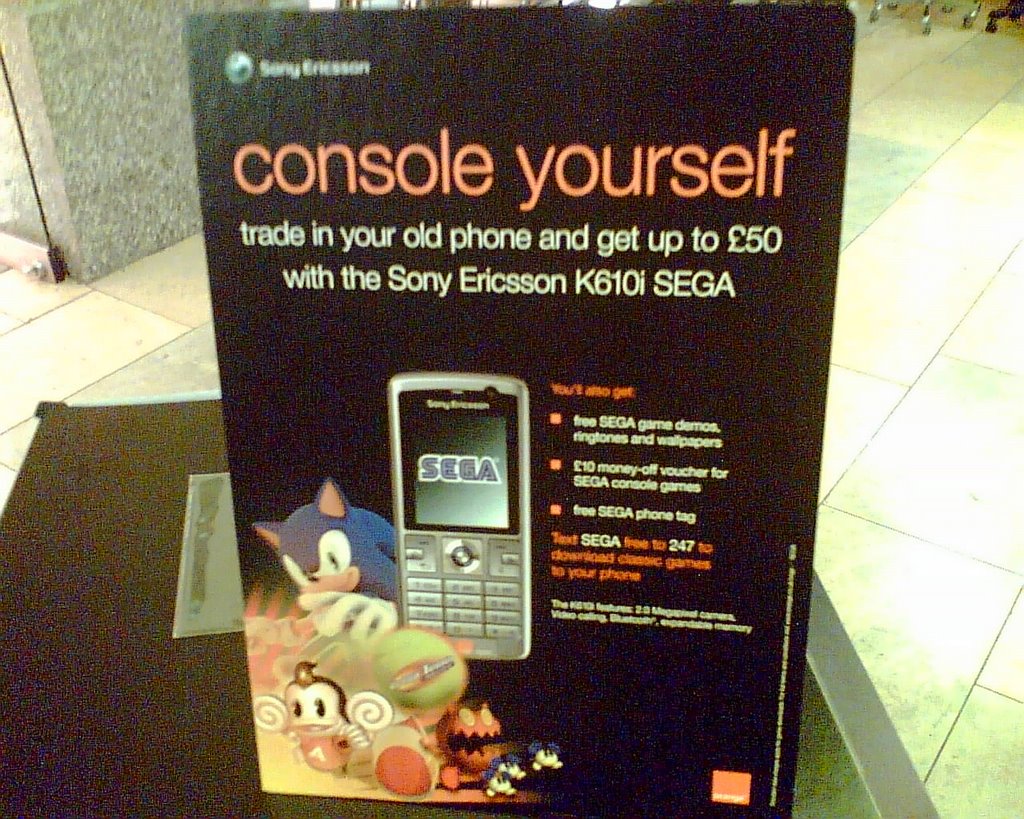
I thought with Nokia's N-gage experiement had put the skids on the gaming phone experiment. Last week I came across this in Paddington station. Very interesting, shows operators and handset OEM's still see the core gamer as a big enough demographic to position phones specially for that segment. Actually, I do see the sense of it, given that mobile gaming has been dominated by casual gamers, there must be a large community of core console and PC gamers out there who are untapped. With more sophisticated handsets and better quality mobile versions of console games, I can see why Operators still believe in the gaming phone. Isn't Sega owned by Nokia though?? Wonder what they're doing on a Sony Ericsson :)!

Wednesday, September 06, 2006

Innovative distribution models for mobile content emerging in India

Some time back I had posted a blog on the importance of alternative (non GPRS) distribution channels to drive mobile content sales in markets like India with extremely low GPRS penetration and highly price sensitive customers. Pantaloon, though its Big Bazaar retail outlet has done just that (See article from Contentsutra pasted below). My big issue though is I'm not clear from the article whether the content is still delivered over the operator's network. If this is the case, users without GPRS can only download mono ringtones and the solution only helps Pantaloon and the content owner make more money by doing away with the operator's cut for PSMS billing. I don't see any real value propostions for the end consumer. On the other hand, if the content is delivered using bluetooth or some other point of sale chanell, then a much wider consumer base can be covered and offered a greater variety of content.

Airtel had already started the trend with their Airtel Easy Music outlets, which allowed subscribers to purchase songs and ringtones for their phone from their retailo outlets. I think this is an interesting experiment from Pantaloon and something that can become a major distribution channel for emerging markets, at least in the short run. Regional language voice portals and IVR based browsing in regional languages is another trend I'm keeping my eyes open for.

One97 And Pantaloon Launch Universal Ring Tone Card
By Nikhil on Wed 06 Sep 2006 09:02 AM IST

First Airtel went the retail way with Hello Tunes and MP3 songs from Soundbuzz being made available at Airtel Easy Music outlets; now One97 has launched an all operator, all mobile ring tone card which is being retailed at Pantaloon’s Big Bazaar stores.The ring tones are availabe in single tone (Rs.6) and three tone(Rs.18) packs at Big Bazaar stores. Users have to send a unique 10 digit PIN alongwith their preferred ring tone(s) code via SMS to 9871330303, and avoid the premium SMS and call charges. The card has a 6 month validity. One97 also has plans for more ring tone cards, Astro cards and regional ring tones.On the face of it, it looks quite convenient and cost-effective, but that’s because premium SMS and call charges are are high with the operators cut being a major component. I wonder how many people actually will be picking up ring tone cards alongwith their tomatoes and onions. My guess is that the cards will be placed near the checkout counters, as impulse purchases, next to other impulse-purchase favourites like razors, chocolates and chewing gum.

Tuesday, August 15, 2006

User generated content - my new addiction!

As anybody in the digital media world knows, nothing is as hot as user generated content these days. I for one, had been slightly skeptical about why people would pay to watch grainy, out of focus videos of some drunk guy singing to his mates, or some supposedly funny fake gag. However, much to my own horror, I find myself a user generated video junkie today!

It all started on the day O2 finally activated my O2 Active. Browsing through their deck, I came acorss a link called LookatMe! What's this I thought and jumped right in. It said "We've got some of the coolest videos and they've been created by people like you on thier mobile. Some are earning serious cash in the process! Think you can do better?". Below this was a preview image of a video with a "buy for 35p" link and a "vote link". 35 pence, I thought, that's nothing, let me check it out. Clicked on buy and in a few seconds I was watching a dude in white trying to do slam dunks for about 50 seconds. It wasn't particularly funny or well shot. The point however is that it was priced so low that I didn't mind ending up with a lemon. So I clicked back to the home page and found a few search categories -most watched, most recent, by same contributor- and randomly downloaded a few more videos. Some funny, some really bad, some downright bizzare.

In a couple of hours I found myself back on the same page, downloading more videos. Soon, everytime I had some time to kill I was shelling out 35p for some vidoes. Before I knew it I was hooked and then I asked myself just why I was so hooked on downloading mostly bad videos. Two thing struck me - 1. Humans are fundamentally voyeurs. We like to peek into other people's lives; like a fly on the wall, observing unobtrusively. 2. We are all suckers for low price points, low price points encourage impulse purchsases

LookatMe has got their model right! Low price points are sustainable because of volumes and not having to pay hefty content publisher or rights owner revenue shares.

Monday, August 14, 2006

O2 active - am I rich enough to download?

So I finally managed to activate GPRS on my O2 phone and was very excited about checking out O2 Active, the operator's home portal. The portal looked rather plain and lacked "the look", but I figured the design was functional and that was more important than cool looks. The categories were all standard and and pages loaded really fast. So the browsing experience was far better than anything I'd experienced before, either in the US or in India.

What shocked me though was just how expensive mobile content downloading was (leaving aside data charges). All the games listed under games arcade were retailing at £5.00. Moreover, there were no previews, no trials, only a text description of the game, followed by the option of clicking "buy" and getting charged £5.00. Hmm, interesting! I'm paying £5.00 and I don't even know what I'm getting. Any wonder operators and game publishers are crying about mobile game sales stagnating and % of game users remaining low (despite fervent denials of any such thing from the big boys of game publishing!). Just imagine how many more browsers will convert to purchasers if they could trial the game before purchasing it, or if they could "rent" it at a lower price point. I would bet on an increase in conversion of at least 30%, if not more.

It wasn't just games that were expensive. Wallpapers, standard celebrity wallpapers and even some really crappy non-celebrity ones were going for £2.00, ringtones for £2.50 and truetones for £3.50. Way too expensive for mostly 'not so hot' content.

The one big surprise though was that video was priced so low! Most video clips, typically from TV shows and comedy clips, retailed at only £0.75, which was great. I did not even think twice before downloading videos at that price point. I'm not sure whether the low price point of video is because O2 is trying to promote video downloads or whether revenue share agreements or rights acquisiton costs allow videos to be retailed so low. The important point though is that the price point is low enough for impulse purchase, which is key to driving volumes and getting more people hooked to content downloading .

I'm hoping O2 and the other operators crack the pricing conundrum soon.

Thursday, August 10, 2006

Different country, same story - My heroic GPRS enablement saga

So here I am in the UK, supposedly one of the most advanced mobile content markets in the world. I ordered myself an O2 contract phone (Nokia 6230i) online, and was assured that to activate GPRS all I needed to do was call the helpline and ask them to activate it.

As soon as I got my phone last Wednesday, I called O2's helpline and asked for my GPRS to be activated. The woman at the call centre took down my phone number and a few other details and said that I would receive an SMS with the settings for GPRS. Thank you very much, simple enough! After waiting for an hour and no SMS in sight, I called again and went through the same process. Still no SMS. Finally, I decided to check the O2 website and found a simple form which needed to fill out to get the settings on my phone. As soon as I filled in the form and hit submit, the much awaited SMS finally arrived. Great going I thought, and opened the SMS and went though the instructions to instal the settings on my phone. Everything went smoothly and the settings were indeed installed. Sadly though, when I tried to access O2's home site, I was told that GPRS was not available for this connection.

Many calls to customer support followed, bulky documents were emailed to me and many experiments were made. GPRS remained elusive still. Completely frustrated by now, I walked into an O2 store today hoping my problem will be solved. Two store assistants came by one after the other and simply said that I need to talk to their customer support. They were kind enough to call customer support and hand the receiver to me. Thrice I was informed that I had got through to the wrong department and was transfered to some other call centre agent. As I was getting ready to leave and throw my phone into the Thames, a senior person, presumably the store manager walked upto me and asked if he could help. I wanted to say, "most definitely, please show me the way to the river", but instead explained my problem to him. He said "please come with me sir", much like a police inspector leading you to detention room and called up a number from his phone, which I suspect was a hotline to the GPRS god. A 30 second conversation followed during which he gave my phone number to the GPRS god and I was told that GPRS was now active and handed back my phone with a flourish. In a feverish daze I fumbled and clicked on the "web" button on my phone and MAGIC, there it was ,the O2 Active home page!!!

What on earth is going on? Why can't Operators/ handset vendors preconfigure phone for internet access? Especially given that O2 and other operators in the UK charge per kb of data usage and not a monthly data subscription like other markets. The next time I'm asked what needs to be done to increase mobile content revenue revenue, I'm just going to grab the fellows phone and throw it into the river!

Monday, July 10, 2006

More lies and fantasies..

Business Standard and The Hindu carried an article on July 7, 2006 about mobile content revenues in India touching $5 bn in the next 2 years. The figures come from the ‘second international conference on VAS’ held in Delhi (?). The article makes vague references to contextual applications like “advertisers projecting ads at the right moment in entertainment videos” and “cultural marketing” as possible drivers for this stupendous spurt in revenues from the current sub $10 million levels.

I agree that positive spin is necessary in every growth industry. But these numbers are in the realm of fantasy. I’m tempted to ask what the person who quoted these numbers was smoking when he dreamt them up? As mentioned in a previous blog, grossly false numbers are a big issue plaguing India’s mobile VAS industry. I think in the long run, this blatant inflation and false projection will hurt industry players where its really painful. One can foresee a scenario where investors become extremely wary of putting in the money for innovation and infrastructure, which are vital to spur legitimate growth in Mobile VAS sector. Yes, mobile VAS is growing in India and will eventually be a major revenue generator. However, the industry need to be realistic about time frames for this. Here’s hoping that some sense prevails and business writers do a sanity check before publishing articles with blatantly false growth stories.

Friday, July 07, 2006

Why mobile games need smart retailing..

A recent Business Week article (Tiny games for a giant market, June 23, 2006) about mobile games brought out some fairly obvious but interesting facts about the mobile gaming industry. The article estimated that mobile gaming could be an $18 billion business by 2010, exceeding ringtone and SMS revenues. While painting this optimistic picture, the article also highlighted some key obstacles the industry will have to overcome to meet these forecasts. A few thoughts on how game developers and publishers can use retailing models from the physical retail world to scale up exponentially:

- Games not appealing enough

While the Trip Hawkin’s (CEO, Digital Chocolate, a leading mobile game developer and publisher) and Larry Shapiro’s (VP,Walt Disney Internet Group) of the world go on about socially networked games and multi-player games as the future, the industry needs to step back a little and look at typical mobile game playing behavior . As the article mentions, casual games form a majority of the mobile gaming market. Clearly, the consumption behavior of mobile games lends itself to this. A majority of mobile game playing happens in 'time killer mode' – while waiting for a train, at the dentist, at an airport, etc. This means the game needs to be easy to learn and easy to play without requiring great skill or concentration. Therefore, game developers and publishers should focus on producing great “casual games” which have mass appeal instead of putting their effort on reproducing console games for the mobile or games with great special effects.

- Prices too high

The economics of downloading a game over the operator’s network means that game publishers have very little option but to price their games at $5 or higher. It is hard to imagine operators lowering their obscenely high share of content revenue in the foreseeable future (between 30% and 50%). This means that the onus is on game publishers, distributors and content retailers to drive down price points and make it more attractive to consumers to spend their money on mobile games.

One option is to use technologies that give consumers flexible pricing options like rentals for “n” plays of the game. So for example, a consumer with 15 minutes to kill at an airport may be willing to spend $1 for 3 plays of a game, but may find the $5 price point for outright purchase too high.

A second option is to use distribution options that bypass the operators network, thus allowing games to be retailed a much lower price points. These options include Bluetooth kiosks, PC based purchase and transfer to the phone, etc. However, the bigger publishers who are currently dependant on operator decks for a majority of their revenues may risk incurring the wrath of operators by pushing too hard on alternative distribution. Mitch Lasky’s (Electronic Arts) recent comments on going D2C and the subsequent “misquote” drama is sufficient proof. Interestingly, physical retailers all over the world are waking up to the possibility of retailing mobile content through their retail outlets and are keenly exploring options.


- Only 4% of mobile users purchase or download games.

Surveys show that while 50% of mobile users play games that are pre-loaded on their phone, but only 4% actually purchase and download games. While a number of factors may influence purchase behavior including data plan subscription, price sensitivity, etc, a tried and proven way of increasing purchase behavior is to offer free trials of games, in other words “try before you buy”. Try before you buy is not a new concept and has been around for at least a couple of years now and most game publishers and retailers acknowledge the success they’ve experienced. However, the problem game publishers face is in re-writing game code to enable try before you buy for their large catalogs (larger game publishers have 30,000 SKU's or more), across all the hundreds of devices and network and billing anomalies. The need of the day is a technology or tool that allows game publishers to enable try before you buy easily and distribute games in minimal time. Such tools already exist in the market and game publishers need to partner with technology companies and make investments if required to refine and develop these tools.

Here's to the $18 billion pie that's there for the taking..

Tuesday, June 20, 2006

Airtel's data plans are detrimental to growth of VAS

As anybody who’s tried to download content over Airtel knows, the experience is frustrating enough to put you off content downloading for a long, long time. I have been an Airtel GPRS subscriber for nearly 2 years but have never been able to figure out the different types of GPRS schemes available to subscribers.

Now, lets see what an Airtel subscriber has to wade through in order to download content. The basic GPRS package on Airtel is called Airtel Live and gives you access only to Airtel’s portal or walled garden. There is no GPRS monthly rental or data charge to activate Airtel Live, but the user explicitly needs to request for Airtel Live activation. Airtel Live activation only allows access to the Airtel Live portal . However, the portal itself requires a subscription of Rs. 30 per month in order to download any ringtone, image or game. The Rs.30 subscription gives you ‘free’ content worth Rs30 and any further content downloads are charged per download. Typical ringtones are Rs7-10 and games retail at Rs50 –Rs100 per game.

Another package called Mobile Office, which I'm subscribed to, allows me to download mail from my office server and access any WAP/WEB site I want to. Mobile office subscription is Rs 600 per month for unlimited data access. Here's the extremely bizzare bit - despite being a Mobile office subscriber, I cannot download content from any 3rd party WAP site such as Yahoo! mobile of Indiatimes. I can access the sites but any attempt at downloading gives me a message that says "You are not authorized to download". Completely perplexed, I called Airtel only to find that I needed to subscribe to another data plan called Airtel Online, which would allow me to download content from 3rd party WAP sites for Rs 99 a month.

So now, I have 4 data access points I juggle around with depending on what I'm trying to do - Airtel Live, Airtel Online, Mobile Office and Airtel MMS. How on earth does Airtel expect a lay man to figure out any of this. I do not have any personal experience with Hutch, but I'm told there is just one standard data plan.

I wonder what Airtel's VAS team is thinking. If the idea is to drive traffic only to the Airtel Live portal, then they are being extremely short sighted and haven't learnt from operators world over who are moving away from the walled garden approach. The only other explanation I can think of is that they want to limit data usage until they invest in infrastructure to handle large scale data usage. Either way, one cann only hope that Airtel simplifies its data plans soon and benefits the entire industry by doing so.

Alternate distribution channels for Mobile VAS - necessary for India

Despite all the brouhaha about the phenomenal mobile subscriber growth in India (100 million and counting), ARPU’s’ are falling steadily across all operators and non-SMS data revenues continue to be negligible; With operator strategies primarily driven by customer acquisition, falling voice plan rates and call charges are leading to lower ARPU.

Operators are all talking about increasing ARPU through mobile Value Added Services (VAS). Advertsising campaigns from operators are increasingly talking about content and services as differentiators. While SMS based infotainment services are growing rapidly (Kaun banega karorepathi alone generated more SMS traffic than any other interactive TV show in the world), the big ticket content downloads are yet to take off. Content downloads that do happen are largely mono ringtones that are delivered as part of the SMS payload and do not need GPRS connectivity. Reality is that GPRS penetration is abysmally low, at best around 2% in the major cities (Source: Netsize guide, 2006)

While everybody in the value chain, from operators to 3rd party service providers to content and media companies desperately want to drive mobile content revenue, there are 4 major factors that still impede mobile data revenues from crossing that point of inflection -

1.Complicated and confusing GPRS plans, atleast from the GSM operators, making it difficult for the lay person to configure their phone for GPRS
2.Lack of robust operator infrastructure which makes GPRS downloading an extremely frustrating experience.
3.Price sensitive consumers
4. Easy availability of pirated mobile content

Despite the roadblocks, I still believe that mobile VAS is a huge opportunity in India, not just in the long term, but also in the near term. Firstly, the large youth segment, is extremely mobile savvy, has a high penetration of data capable mobile phones, is hungry for entertainment and personalization and increasingly has disposable income. And here's the best part, its not just youth in Mumbai, Delhi or Bangalore who have high end phones, I have seen young people in small towns all over the country carrying the fanciest and latest phone models. Secondly, media and entertainment companies are driving direct to consumer VAS. They're spending the advertising rupees (hoardings, ad spots), they've tasted success with SMS services and are eager to see higher margin content downloads take off.

In the long term, media brands will influence operators to improve infrastructure and bandwidth and make sure that prices come down, both for data plans and content purchase. The interesting opportunity though is in the near term. How do you translate the opportunity that 100 million mobile subs present into money on the table today? The answer, as Dylan said , is blowin in the wind and probably lies in using "Alternate distribution channels" for mobile VAS.

This is not rocket science but simply making use of local knowledge and experience, combining it with some simple yet innovative technology solutions and packaging it all nicely for the user. The "Alternate distribution" winds are already blowing. Airtel has started music downloading service at Airtel retail stores across the country. The user experience is not great but its a start and can only get better and bigger as innovative companies partner with Airtel. A major retail chain (which I cannot name for confidentiality reasons) is already in talks with several service providers to set up point of sale mobile content kiosks which use bluetooth or some other technology to distribute content, coupons and promos at its retail stores all over India. These "Alternate distribution" chanells make use of footfalls and "trusted brand" image of major retailers, can drive down costs for the consumer by over 50% (no need for Operators network and billing charge) and also help to educate consumers about mobile VAS.

Moreover, these "branded stores" can establish themselves as bona fide mobile stores in the future, similar to web stores like amazon.com today. The physical store experience can be extended to the phone through WAP stores or device resident applications as the GPRS base in India improves and grows.

The bottom line is that "Alternate Distribution" of VAS in India appears to have tremendous potential and presents a great opportunity for any new innovative technology provider or service provider who can address the user expereince problems that physical retailers are trying to figure out.

Friday, June 16, 2006

Inflated mobile content numbers hide the true picture

Business Standard, in an article on Jun 12 says India's Value Added Service (mobile content) market is expected to touch Rs 3,000-4,000 crore ($900 million) by 2007.

The 3000-4000 crore number is so ridiculously inflated that it borders on the amusing. In fact one of the biggest issues in the mobile data services landscape in India is lack of accurate reporting. There are plenty of anectdotal numbers floating around with Yahoo and a couple of operator portals claiming over a million downloads a month for mobile content. Anybody who cares to dig in will soon realize that facts and numbers just dont add up. GPRS penetration is less than 2%, the download experience is frustrating and inconsistent, operator data plans are complicated (Airtel’s Airtel Live, Airtel Online and Mobile office are confusing enough!) and operator walled gardens dont help either. The only form of mobile content doing well in India are probably mono ringtones which can be ordered easily and delivered as an SMS.
Operators need to wake up to reality and simplify data plans and tariffs, allowing media companies to drive the off-portal market. Otherwise, the kind of mobile content numbers being forecast are not going happen anytime soon.